Introduction
This is the third installment regarding insects that take up residence in our homes and offices, finding a warm place to pass the winter. This one is about the Multicolored 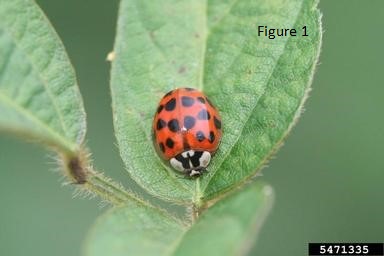 Asian Lady Beetle (MALB), Harmonia axyridis. This beetle was intentionally introduced from Asia for biological control of insect pests, specifically aphids, and accidentally many times during the 1900’s. It became established and rapidly spread over the entire United States. By 1994 it had completely colonized the entire United States and parts of Canada.
Description
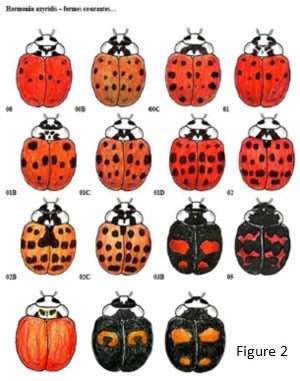 MALB adults appear in several different color patterns varying from solid orange, orange with black spots, red with black spots, black with four red spots or black with two red spots. In the orange and red morphs, the number of spots varies from none to 22. The black forms are very rare in the US. (Figure 2)
One easily identifiable feature in the typical orange morph that distinguishes this lady beetle from others is the predominantly 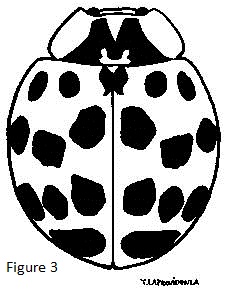 white pronotum has a series of black markings resembling the letter “M” or “W” depending on a frontal or rear view. It is very obvious in the forms with many spots, not so obvious in those with just a few or no spots. In some case one really has to use ones imagination to see the “M” or “W”. (Figure 3)
Behavior
As the weather begins to cool, generally around the first of October, and aphid prey is becoming scarce, flights to overwintering sites are triggered, and occur progressively from northern to southern latitudes. In North Carolina these flights will generally occur from mid-October to mid-November. The beetles will aggregate in large numbers on structures which usually are white, beige, or tan and mostly on south or west facing walls because these surfaces are very highly reflective and visible to the beetles for miles. In their native Asian range, they congregate on light colored rock formations where they overwinter in cracks and crevices. In addition, once entrance is gained into a structure, the beetles release an aggregation pheromone making it even more attractive to more and more individuals. Unfortunately, evidence of this pheromone remains in the building and makes it attractive to beetle infestation the following winter.
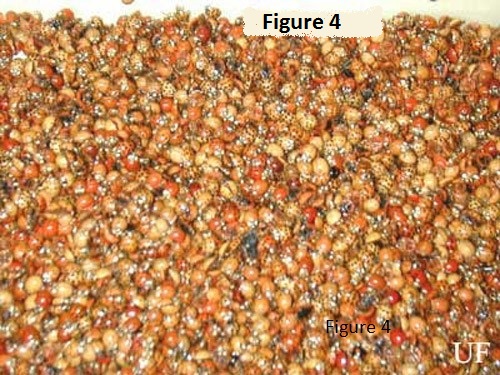 As a result of this overwintering behavior, the beetles are a nuisance during and after the flight period as they aggregate inside walls and other parts of homes or offices. The beetles may enter houses in large numbers with tens of thousands common (Figure 4). Once inside the walls, under floors, in crawl spaces, and attics they will crawl around looking for a cool sheltered location. With very high populations, the movement can be heard inside the house. During the winter, interior walls are generally warm and beetles near these walls do not become dormant and consequently they are continually moving about and will often follow wiring and conduits emerging from wall outlets and ceiling light and fan fixtures and fly about the room and land on walls, drapes, furniture. If crushed or disturbed, the beetles will bleed a thick yellow foul-smelling fluid from their leg joints which will stain skin, furniture and wall hangings.
Managing the Beetles
The best strategy is to exclude the beetles before they enter. Seal any cracks, crevices, or holes around exterior windows and doors with caulk. Ensure that soffits around eaves are tight fitting. Most gable vents are fitted with ¼ or 3/8-inch hardware cloth to prevent insects from getting into the attic. Tack window screen over the hardware cloth on the attic side.
If already inside the building and are accessible, use a vacuum cleaner to suck up the beetles. Be sure to empty the bag or canister in a timely manner because the beetles have a disagreeable odor which will permeate the vacuum.
Ken Ahlstrom, Ph.D., Economy Exterminators, Inc., Apex, NC 27523
Picture credits:
Figure 1 – Darren Mueller, IA State Univ. Bugwood.org
Figure 2 – Economy Exterminators, Inc.
Figure 3 – Kimberly Stoner, CT Agr. Exp. Sta. New Haven
Figure 4 – Russell F. Mizell, Univ. of FL