How to Identify Black Carpenter Ants
 How to Identify Black Carpenter Ants
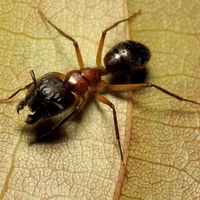
Carpenter ants will usually be in large numbers and are brownish-black in color. Workers are 1/8 to 1/2 inches long but vary greatly in size. They come in several color forms. Some are completely black, some are reddish and some are a combination of red and black. Carpenter ants are some of the largest ant species that we have in Raleigh, Durham, Chapel Hill, Wilmington, and Charlotte.
If the ants are about 1/8″ long and look like they have a stinger on their back end, they might be Asian needle ants. If they’re in great number and extremely small, they might be Argentine ants, which can only be identified via microscope. If the ants are red and located in mounds of soil or dirt outside, then they are probably fire ants, and you should probably stay away because they can sting! If the insect gives off a slight coconut odor when crushed, then it is probably an odorous house ant.
It is very important to know which ant species you have since their habits and food preferences vary greatly.
Ants are now among the most important pests both residentially and commercially.
This is due to their mere presence as an overwhelming nuisance pest.
Where Do Black Carpenter Ants Come From?
- We are living in the carpenter ants’ neighborhood. The carpenter ant has a moderately-sized colony that can consist of up to 3,000 workers and which takes approximately 3 to 6 years to mature.
- Carpenter ants can have satellite nests, which increases the numbers of workers. There is usually only one queen per nest.
- Swarmers appear from May to August. Most carpenter ant nests start outdoors in decaying logs, rotting fence posts, stumps, old firewood, damaged trees or in structures that may have wood that has been damaged by moisture.
- Incidents of damage can be found in North Carolina and extend into the northern states.
Where do you See Carpenter Ants?
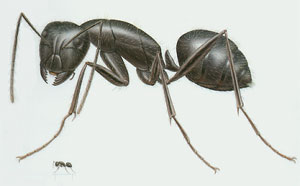 Carpenter ants cause millions of dollars of damage in the United States due to the destruction of wooden structural components. These pests are usually seen for the first time on the exterior of the structure. They gain access to cracks and crevices around windows, doors, eaves and the foundation.
Carpenter ants will follow tree branches into the structure. If they are seen more than once inside, this usually indicates that they have moved into the structure, but sometimes you can have carpenter ants without even knowing it.
Once inside, they can be seen almost anywhere in the home or structure. They crawl behind Masonite siding that has been damaged by moisture or has a high moisture content and then move through insulation and into sound wood in wall voids. They will also invade water-damaged window and door frames.
Sometimes the only way that carpenter ants are noticed is the rustling of the winged swarmers in wall voids, or by the windows that they create. These are small slits or openings (“windows”) where they expel debris – small wood shavings or dead insect body parts. Carpenter ants are most active between 10 pm and 2 am but some workers can be seen almost anytime during the day.
Feeding Preferences of Black Carpenter Ants
Inside the home, the carpenter ant prefers the following: sweets, eggs, meats, and grease. Outside the home, carpenter ants feed on both live and dead insects. They also show a preference for honeydew, which is a secretion from aphids and scale insects feeding on plants. Carpenter ants can travel up to 300 feet from the nest and sometimes make a very distinctive active trail that they clear of vegetation and debris to access food. They do not eat wood; they just excavate cavities to house their nests.
Do-it-yourself ways to reduce the conditions that harbor and attract the carpenter ant:
- Repair moisture-damaged wood inside and outside structure
- Trim tree and shrub branches off of structure
- Remove dead trees, damaged post, logs and stumps
- Seal gaps around doors and windows
- Repair foundation cracks
- Clean gutters and downspouts of debris
- Clean garbage cans
- Move garbage cans 25 feet from structure
- Clean all pet food dishes and remove spilled pet food
- Repair all leaks in structure
- Seek professional assistance and a pest prevention plan
Economy Exterminators’ Pest Control Solutions program uses the 4-step approach to solve your carpenter ant pest problem:
- Our 1st step is the inspection of the property by a customer service specialist. It is very important to know the species involved and the severity of the pest problem. There are many areas that our inspectors check to identify as areas that need to be treated to give the best results. These areas consist of carpenter ant runways, dead portions of standing trees, areas of high moisture in wooden members and touching trees, etc.
- The 2nd step would be the initial treatment by a customer service specialist of all areas that the inspection revealed as critical areas. Economy Exterminators uses the newest and most effective materials to solve this pest problem quickly for you. Typical critical areas would be outside areas, fascias, storage areas, crawlspaces, and garages. On the outside, special attention will be applied to all the windows, doors, eaves and the foundations. Special time and effort will be spent locating ant trails and nests.
- The 3rd step is a 37-point inspection of your property to identify areas on your property that give the carpenter ants easy access by either direct access (cracks in the foundation) or food sources that would be attractive to this type of ant.
- The 4th step is an ongoing maintenance program for the next generation. New infestations will be moving onto your property from the adjoining property. Our exclusive Pest Control Solutions program is designed to prevent the next generation at your property in the Raleigh, Durham, Chapel Hill, Wilmington or Charlotte area.